
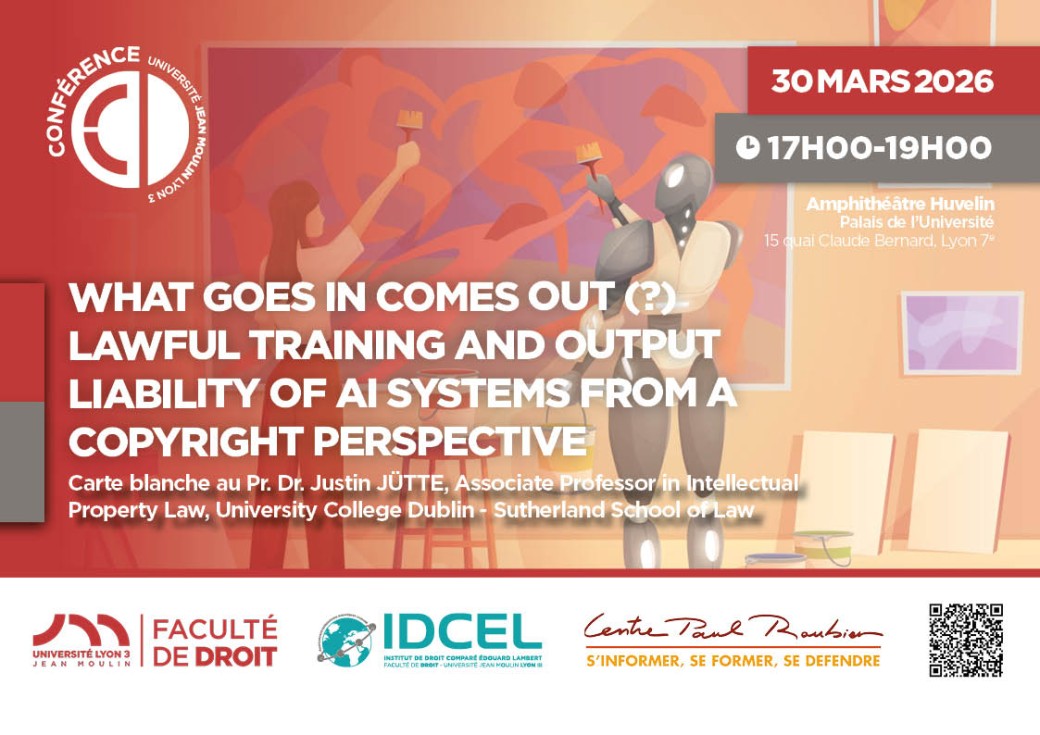
Lawful training and output liability of AI systems from a copyright perspective
By
EDIEC
Mon Mar 30, 2026 from 05:00 PM to 07:00 PM
Timezone : Europe/Paris
15 Quai Claude Bernard, Lyon, France

Developing artificial intelligence (AI) systems and models, including large language models (LLMs) and foundational models, requires training such models on a large amount of data, much of which is protected by copyright. The lawfulness of training, but also the ability of AI to create outputs based on, and often similar to data contained in training datasets, raises critical legal questions, to which different national legal copyright regimes have developed different approaches. While the European Union (EU) has developed an express exception for text-and-data mining, courts in the United States (US) apply the established fair use doctrine to AI training. Neither jurisdiction has developed a special statutory approach to potentially infringing outputs, and courts are beginning to apply the traditional copyright infringement test to allegedly infringing outputs. The intervention will examine AI training and AI-generated outputs from a comparative EU-US perspective, looking at statutory law as well as the jurisprudence of selected national courts.
Date and place
Mon Mar 30, 2026 from 05:00 PM to 07:00 PM
Timezone : Europe/Paris